
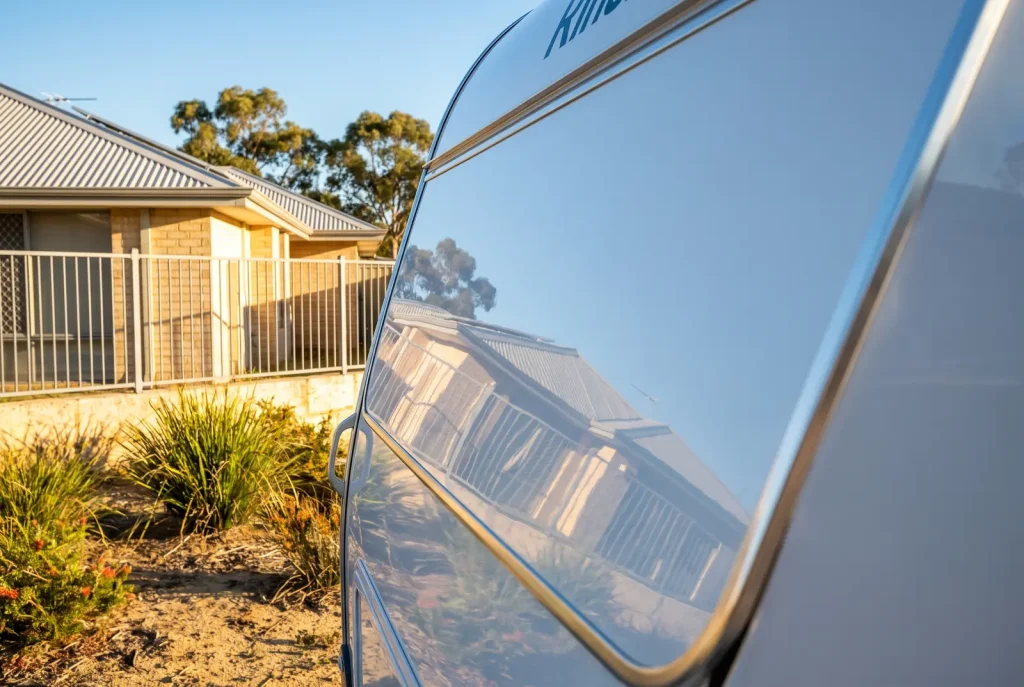
Think about how your caravan actually spends its year. A handful of trips away, maybe a long weekend here and there, and then long stretches sitting on the driveway or in a side yard. For most owners, the van is parked far more than it travels. Yet protection tends to only cross our minds before a big trip or ahead of formal storage. As Perth caravan detailing specialists, we see the results of those neglected between-trip periods firsthand — slow, cumulative damage that builds up while everyone assumes the van is “fine”.
This isn’t about a full seasonal routine or shutting a van down for months. It’s about the short idle stretches where a little attention prevents surfaces from quietly degrading.
Prefer to watch or listen?
Listen onApple Podcasts
Why Short Gaps Are Riskier Than Owners Assume
The danger in a parked caravan is that nothing looks urgent. There’s no drip on the floor, no obvious fault. But exposure is relentless. Perth’s UV is among the strongest in the country, and it fades gelcoat, chalks paint and breaks down surface sealers whether the van moves or not.
Dust settles constantly. Left alone, it holds moisture against the surface and works into the fine texture of fibreglass and painted panels. Add salt air if you’re anywhere near the coast, and you get a slow corrosive load on aluminium trim, fittings and fasteners. Bird droppings are worse again — they’re acidic and can etch into a finish within days.
None of this happens fast enough to notice week to week. That’s exactly why it does damage. By the time it’s visible, it has usually bonded to the surface.
Choosing Where and How You Park
Where a van sits between trips shapes how much wear it takes. A few decisions cost nothing and reduce exposure straight away.
- Face the van so the most exposed side gets shade during the harshest afternoon sun where possible.
- Keep it off bare dirt or lawn that throws up dust and holds ground moisture around the underside.
- Avoid parking directly beneath overhead wiring or perches where birds gather.
- Angle the van so water runs off cleanly rather than pooling against seams or low points.
A hard surface with reasonable airflow around the van is far kinder than a tight, shaded spot that never dries out.
Covering and Shading Without Trapping Moisture
Shade helps, but the wrong cover can cause more harm than no cover at all. The problem is moisture. A cover that sits tight against the surface, or one made of a non-breathable material, traps condensation underneath. That warm, damp layer against the panels encourages mould and can lift or dull a finish over time.
If you use a cover between trips, choose a breathable one designed for the purpose, make sure the van is dry before it goes on, and check that it isn’t rubbing against edges or fittings in the wind. Constant abrasion from a flapping cover can wear through a finish faster than sun would.
A carport or shade structure that keeps direct sun and droppings off while letting air move freely is usually the better option for short idle periods. You get the UV protection without the trapped humidity.
Keeping Surfaces Clean During Idle Weeks
The single most useful habit is simple: don’t let contaminants sit and bond. Dust, salt and droppings are far easier to remove while they’re fresh. Once they’ve had weeks to cure onto fibreglass, aluminium or painted panels, they need much more effort — and more aggressive cleaning — to shift.
A gentle rinse to knock off loose dust, and a quick spot-clean of any droppings when you notice them, keeps the surface in good shape without a full wash every time. The goal isn’t a showroom finish during idle weeks. It’s stopping anything from adhering long enough to cause staining or etching.
How Existing Protection Changes Your Routine
If your van already carries a protective coating, the between-trip picture gets easier. A quality ceramic coating creates a slick, hydrophobic surface that dust and grime struggle to grip. Droppings and contaminants tend to sit on top rather than bonding into the finish, so they rinse away with far less effort.
That doesn’t mean you can ignore the van entirely — UV and salt still apply, and a coating works best when it’s kept clean. But it does shorten your routine considerably. A coated van generally needs a rinse rather than a scrub, and it recovers from a few weeks of neglect much better than an uncoated one.
A Realistic Between-Trip Rhythm
How much you do depends on how you use the van.
- Weekend and frequent travellers: a quick visual check and a rinse every couple of weeks is usually enough. You’re using the van often, so problems get caught early.
- Longer-gap owners: if the van sits for a month or more between trips, plan a proper look-over and clean at least monthly — clearing droppings, rinsing salt and dust, and checking the cover is doing its job rather than trapping damp.
The point is consistency, not intensity. Small, regular attention beats an occasional heavy clean-up after damage has already set in.
If your van has been sitting untouched and you’re unsure where to start, it’s worth reading through the groundwork involved in preparing a caravan for long-term storage, then scaling that thinking down to suit a shorter idle period.
What’s easy to miss in all of this is that the most vulnerable parts of a parked van usually aren’t the panels you can see. It’s the joins, seams and roof areas where UV and moisture do slow, unseen work — the places a rinse never really reaches. Even a well-kept van can develop hidden weaknesses at its seals and roof, and those are worth understanding before they turn into leaks.