
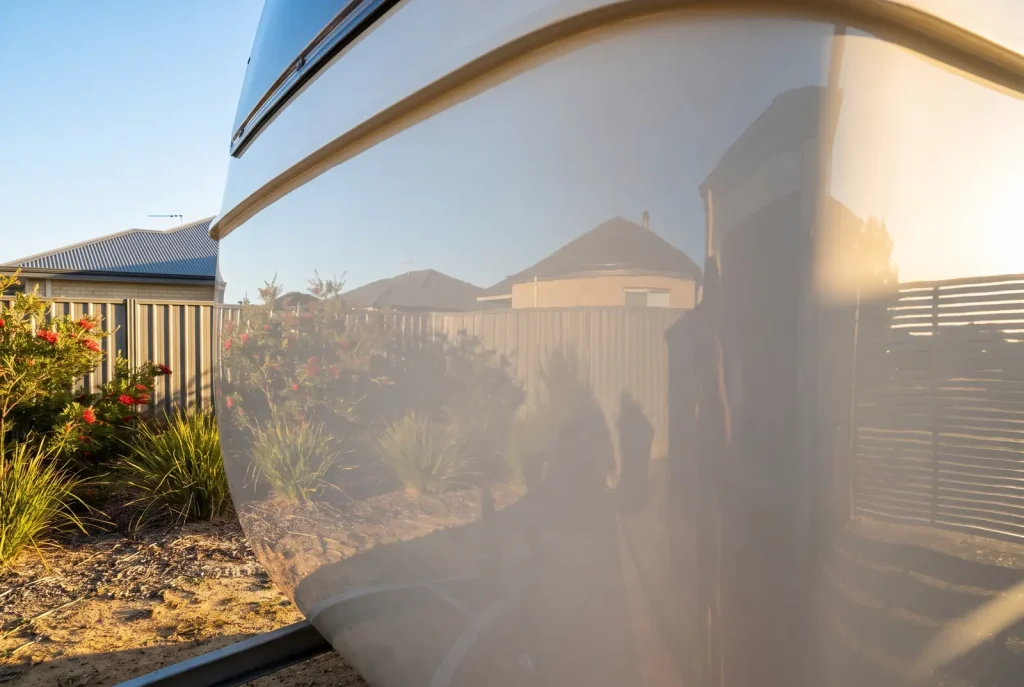
Picture a caravan sitting in the driveway between trips, week after week, under the full glare of a Perth summer. It looks fine. It isn’t being driven, washed by rain, or scraped by gravel. Yet the moment sunlight touches its surfaces, deterioration begins – and it never really stops during daylight hours. Most owners assume their van is safe simply because it’s parked, but understanding this invisible damage is exactly what drives the approach used by our local caravan detailing team. Once you know what UV actually does at a material level, the reasons behind fading, chalking and cracked seals stop being a mystery.
Prefer to watch or listen?
Listen onApple Podcasts
What UV Radiation Is and Why WA Delivers So Much of It
Ultraviolet radiation is a high-energy portion of sunlight that sits just beyond visible light. You can’t see it and you can’t feel it directly, but it carries enough energy to break chemical bonds inside the materials that make up your caravan. That bond-breaking is the root cause of nearly every form of sun-related surface damage.
Western Australia receives some of the most intense UV exposure in the country. Long, cloudless summers, high daylight hours and clear skies all push UV levels up. A caravan stored outdoors here absorbs far more cumulative radiation over a year than one kept in a milder, cloudier climate. The energy adds up day after day, and the materials pay the price.
How UV Breaks Down Gelcoat and Fibreglass
Many caravans are built with a fibreglass body finished in a protective gelcoat layer. That gelcoat is a resin-based coating designed to seal and shine. When UV strikes it repeatedly, it triggers a chemical reaction called oxidation – the same broad process behind rust and rot, applied here to the resin’s molecular structure.
As the resin oxidises, its surface bonds break down and the once-smooth top layer starts to degrade into a fine, powdery residue. This is chalking. Run your hand over an older, sun-worn panel and you’ll often see a dull, milky film left on your fingers. That powder is literally the surface of the gelcoat breaking apart. Left unchecked, oxidation eats deeper, the gloss disappears, and the fibreglass beneath becomes increasingly exposed.
Fading on Painted Panels, Decals and Colour
UV doesn’t only attack clear coatings – it attacks colour directly. Pigments in paint, decals and printed graphics rely on stable chemical structures to hold their hue. UV energy gradually breaks those pigment molecules down, which is why deep colours turn washed-out and vibrant decals fade to pale ghosts of their original shade.
Darker colours tend to show this fastest because they absorb more energy. Decals and stickers are especially vulnerable, since they’re often thinner and less protected than the surrounding bodywork. Once the pigment has degraded, the colour is genuinely gone – there’s no washing it back into life.
Seals, Membranes and Plastic Fittings Turning Brittle
The parts of a caravan that keep water out are among the most at risk. Rubber door and window seals, roof membranes and flexible plastic fittings all rely on softening agents within the material to stay pliable. UV exposure breaks these compounds down, and the material slowly loses its flexibility.
- Rubber seals harden, shrink and crack, letting moisture and dust past defences that used to be watertight.
- Roof membranes grow brittle, and brittle membranes are prone to hairline splitting under heat and movement.
- Plastic fittings such as vents, trims and light housings become fragile and can crack or discolour.
Because these components are frequently overlooked, their failure often becomes the first place water finds its way inside – long after the surface first started to degrade.
Why UV Damage Is Cumulative and Usually Invisible
The hardest thing about UV deterioration is that it happens quietly. There’s no single dramatic event, just thousands of hours of sunlight steadily chipping away at chemical bonds. Each day contributes a tiny amount of damage that you can’t see, and it accumulates over months and years.
By the time a van looks obviously dull, chalky or faded, the process has usually been underway for a long time. This is why the damage feels sudden to owners – it isn’t; it simply crossed the threshold where the eye finally catches it. Regular attention keeps you ahead of that threshold, and it’s worth understanding how washing differs from proper detailing when it comes to genuine surface protection rather than a quick clean.
How Surface Care Slows UV Deterioration
You can’t switch off the sun, but you can slow how fast it wears your caravan down. The principle is straightforward: put a sacrificial protective layer between UV and the vulnerable material underneath. Protective coatings and sealants absorb and deflect some of that energy, taking the hit so the gelcoat and paint don’t have to.
Keeping surfaces clean matters too. Contaminants, grime and existing oxidation can accelerate further breakdown if they’re left to sit. Restoring gloss and removing chalking helps re-establish a sound surface that protection can then bond to. Seals and rubber components benefit from conditioning that helps them hold their flexibility for longer under sustained heat. None of this stops UV entirely, but it meaningfully extends how long your surfaces stay sound.
UV deterioration progresses so quietly that the difference between a van you protect in time and one that needs full restoration often comes down to noticing the subtle early warning signs on surfaces, seals and finishes. Learning to spot the signals that your caravan needs professional attention is what lets you act while the damage is still reversible rather than after it has set in for good.